

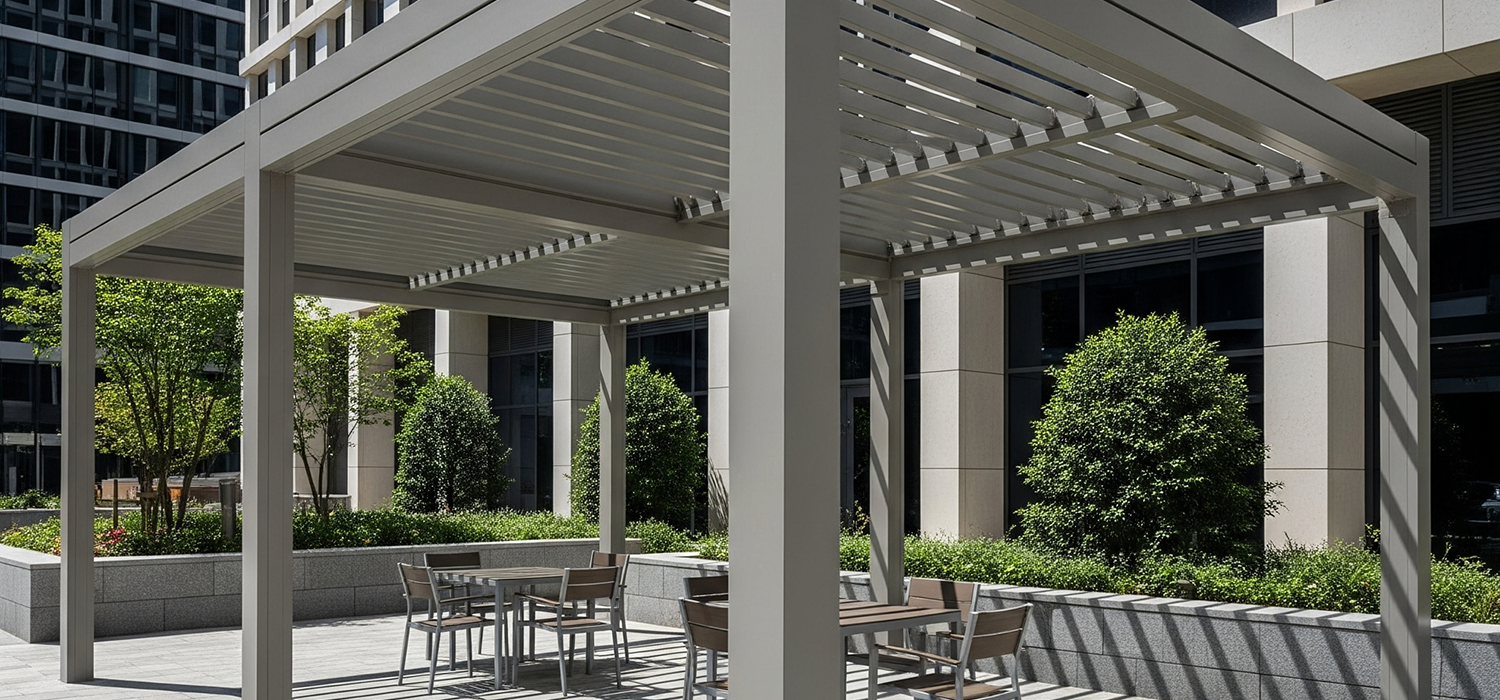
Thinking of adding an aluminium pergola to your café or pub garden? Brilliant move — they’re stylish, practical, and great for creating year-round outdoor space.
But here’s the big question: do you need planning permission?
Short answer: Yes, sometimes — depending on size, location, and how you use it.
Keep reading, because missing a key rule could land you with a fine, or worse, a demolition order.
Installing a pergola might seem like a simple upgrade. But for businesses, there’s a web of planning rules that can’t be ignored.
This guide breaks down what counts, what’s exempt, and what steps to take — so you can build with confidence, not confusion.
In many cases, yes. While homeowners might get away with a DIY weekend project, businesses are held to tighter rules.
Take an independent coffee shop in a conservation area: throw up a timber structure without checking the regs, and you could be forced to pull it down.
On the flip side, a simple aluminium pergola tucked behind an office building might not raise an eyebrow.
Let’s break it down.
Some commercial properties benefit from permitted development rights, which allow small changes without formal permission.
But these rights are more limited than for residential properties — and they don’t apply everywhere.
You may be covered if your pergola is:
Detached and under a certain size
Not facing a main road
Far from a boundary or listed building
Still, there are limits — and you’ll want to double-check with your local authority.
It’s not just size. Here’s what else councils look at:
Height: Over 3–4 metres? You’ll probably need consent.
Proximity to neighbours or roads: Too close? Not allowed.
Use: Using it for seating, dining, or events? It might count as a change of use.
Materials and lighting: Flashy designs might need scrutiny.
A quiet courtyard pergola for staff breaks? Possibly fine.
A lit-up party pergola serving prosecco? Likely not.
Live in a conservation area? Or near a listed building?
Then even minor structures often need permission.
Some areas also have what’s called an Article 4 Direction — a legal restriction that removes your permitted development rights entirely.
If that applies, any changes to the exterior — even paint colour — could need permission.
Some situations are red flags for planners — and almost always need official approval.
If your pergola is tall, wide, or fixed permanently, it's unlikely to be permitted development.
This includes structures with:
Permanent ground anchors
Roofs or covers over 100m²
Open walls but significant lighting or heating features
Think rooftop terrace for a bar or a fully enclosed pergola with retractable screens.
Is your business in a historic district?
Does the pergola block key views or alter the streetscape?
Local authorities care about “visual impact” — especially where character or tourism is at stake.
In those areas, even a sleek aluminium structure might require special sign-off.
This is a big one.
If you’re turning an outdoor space into a full-on dining area or beer garden — complete with pergola, heaters, and music — that’s a change of use.
That means planning permission is very likely required.
Anywhere near a listed building, it’s a different ball game.
You'll need listed building consent and planning permission, even for small additions like a canopy or timber posts.
Do it without permission? You’re looking at serious legal consequences — and no one wants to be in court over a bit of shade.
Don’t be put off by the paperwork — it’s doable. Especially if you plan ahead.
Before anything, speak to your local council’s planning department.
Most offer pre-application advice, often free or low-cost.
You’ll get guidance on what’s likely to be approved — and avoid wasting time on dead-end designs.
For most applications, you’ll need:
A site location plan
Detailed drawings (elevations, materials)
Photos of the current space
A design and access statement, in some cases
It’s worth getting a professional to draw these up — clear plans can make or break your case.
Applications usually cost £200–£500, depending on the project’s scale.
Most councils aim to respond within 8 weeks, though complex cases can take longer.
You’ll be notified in writing if permission is granted — or refused. If refused, you can appeal.
If your pergola is part of a major refurb or tied to a listed site, get expert help.
A planning consultant can handle the red tape.
An architect can tweak your design to meet requirements without losing impact.
It’s an upfront cost that often pays off in speed and certainty.
They’re not the same — and yes, you might need both.
Planning permission is about what you build and where.
Building regulations are about how it’s built — safety, drainage, fire risk, access.
Even if your pergola is allowed, it still needs to be safe, stable, and compliant.
If your pergola includes:
Electric heaters or lighting
Attached canopies near fire exits
Drainage adjustments
…then building regulations may apply. Speak to a Building Control Officer before you begin.
Tempted to skip the process and build anyway? Think again.
If your council finds out — and they often do — you could receive an enforcement notice.
This means tearing it down, no matter how much it cost or how pretty it looks.
There’s also the risk of:
Legal penalties
Trouble when selling or leasing your property
Damage to your business’s reputation
It’s far easier to check first than fix later.
Sometimes it’s worth calling in help — especially if things get complicated.
Consider bringing in a pro if:
Your property is listed or in a conservation area
You’ve received a warning letter
The structure is large or part of a bigger business revamp
They’ll help you navigate the system, avoid pitfalls, and get the pergola you actually want — not the one the council forces you to settle for.
Other articles our customers have found useful:

